
Continuous chemical equipment
provider
provider
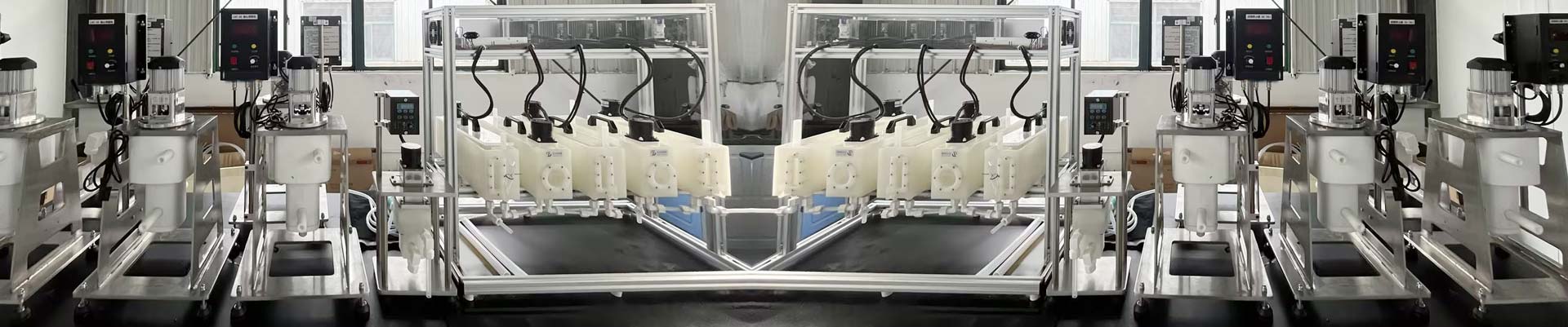
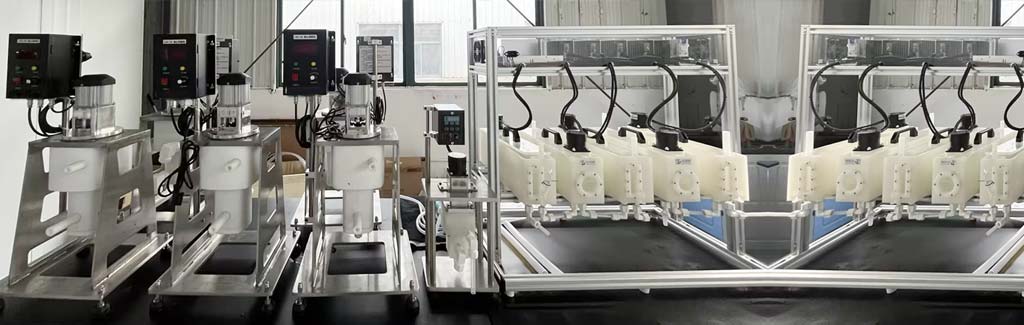
Copper tailings, the solid waste generated during copper ore dressing and metallurgical processes, are produced at an annual global rate exceeding 300 million tons, with China’s historical stockpiles surpassing 6 billion tons. These tailings not only occupy massive land resources, trigger geological hazards such as slope instability, and cause heavy metal migration pollution but also result in the waste of residual copper components—presenting a critical contradiction between the growing shortage of copper resources and the demand for green mining development. The core pain points in current copper extraction from copper tailings include low copper grade (usually below 0.3%), complex mineral dissemination, high difficulty in impurity separation (such as arsenic, lead, and iron), low recovery rate of traditional processes (industry average below 85%), high energy consumption, and prominent environmental pollution. To address these challenges, the industry urgently needs efficient, environmentally friendly, and low-cost core equipment and process solutions. As a key piece of hydrometallurgical equipment, the mixer-settler has become the core support for breaking through the bottlenecks of copper extraction from copper tailings and improving resource utilization, relying on its precise copper ion separation and enrichment capabilities, efficient mass transfer characteristics, and closed-loop environmental protection advantages. This article comprehensively analyzes the professional application of mixer-settlers in the entire copper extraction process from copper tailings, including their working principle, process adaptation, key parameter control, practical application cases, and optimization strategies, providing actionable technical references for industrial upgrading and sustainable development.
The mixer-settler is a classic liquid-liquid extraction equipment widely used in hydrometallurgical processes, consisting of two core components: a mixing chamber and a settling chamber. Its working principle is divided into two sequential stages—mixing mass transfer and phase separation—which perfectly matches the technical demand for separating and enriching low-concentration copper ions from copper tailing leachate. Unlike other extraction equipment such as centrifugal extractors and extraction towers, the mixer-settler adopts a gravity-driven phase separation method, which has the advantages of simple structure, stable operation, easy scale-up, low maintenance cost, strong adaptability to complex feed liquids, and high extraction efficiency—making it particularly suitable for large-scale industrial applications in copper tailing treatment, where feed liquids have low copper concentration, complex composition, and large processing volume.
In the industrial application of copper tailing copper extraction, the mixer-settler is usually arranged in a multi-stage countercurrent configuration, which can realize the step-by-step enrichment of copper ions and the deep separation of impurities. The mixing chamber is equipped with a mechanical agitator driven by a motor, which draws the two phases (aqueous phase: copper tailing leachate; organic phase: extractant) from the settlers of adjacent stages, mixes them uniformly to form an emulsion, and completes the mass transfer process of copper ions from the aqueous phase to the organic phase. The settling chamber is a quiescent zone downstream of the mixing chamber, where the emulsion is separated into two phases by gravity—coalescence plates are usually installed to accelerate phase separation. The light organic phase (loaded with copper ions) overflows through the weir, while the heavy aqueous phase (raffinate) is discharged through an adjustable weir, and the height of the heavy phase weir can be adjusted according to the density of the two phases to ensure stable phase interface position and separation effect.
The copper extraction process from copper tailings mainly includes four stages: tailing preprocessing, leaching, solvent extraction, and electrowinning. The mixer-settler is mainly applied in the solvent extraction stage, which is the core link for enriching low-concentration copper ions and improving the copper recovery rate. Its application effect directly determines the quality of the final copper product, the recovery rate of copper resources, and the economic and environmental benefits of the entire process. Below is a detailed analysis of its application in each key link of the solvent extraction stage.
After preprocessing (crushing, grinding, and classification) and leaching (usually heap leaching or agitation leaching with weak sulfuric acid), copper tailings form a leachate with low copper concentration (usually 0.5~3g/L) and high impurity content. This leachate needs to be purified first (removing impurities such as iron, arsenic, and lead, and adjusting the pH value to 2.0~2.5) and then enters the mixer-settler for extraction operations—the core goal is to transfer copper ions from the aqueous phase to the organic phase to achieve enrichment.
In this stage, the selection of extractant and the control of mixer-settler parameters are crucial. For the low-grade and high-impurity characteristics of copper tailing leachate, high-efficiency chelating extractants (such as LIX984N) are preferred, which have strong selectivity for copper ions, with an extraction rate of less than 5% for impurities such as iron and zinc, enabling deep separation of copper and impurities. The ratio of the organic phase (extractant + diluent) to the aqueous phase (leachate) is usually controlled at 1:1~1:2, and 260# kerosene is used as the diluent to reduce the viscosity of the extractant and improve mass transfer efficiency.
For the mixer-settler, the key operating parameters are strictly controlled as follows: the extraction temperature is maintained at 25~35℃ (normal temperature operation, no additional heating required, reducing energy consumption), the stirring speed is 80~120r/min, the mixing time is 3~5s, and the clarification time is 15~25min. Through 3~7 stages of countercurrent extraction, low-concentration copper ions in the leachate are gradually enriched into the organic phase, and the final copper extraction rate can reach more than 99%, with the copper concentration in the loaded organic phase increased to 30~50g/L, meeting the requirements of subsequent stripping and electrowinning.
In practical operation, emulsification and decreased extraction rate are common problems. For emulsification, a small amount of demulsifier (such as aluminum sulfate) can be added to the mixing chamber, or the stirring speed and feed concentration can be adjusted to avoid excessive entrainment of fine mud impurities. For the decrease in extraction rate, it is necessary to timely detect the concentration of the extractant, supplement fresh extractant, and check the purification effect of the leachate to ensure that the impurity content meets the extraction requirements.
After the extraction stage, the loaded organic phase (containing enriched copper ions) will inevitably entrain a small amount of aqueous phase, which contains impurities such as iron, arsenic, and sulfate ions. If these impurities are not removed, they will affect the quality of the final copper product and corrode the electrowinning equipment. Therefore, the loaded organic phase needs to enter the mixer-settler washing stage for purification.
In the washing stage, clean water or dilute sulfuric acid solution is used as the washing liquid, and the mixer-settler operates in a countercurrent manner. The key is to control the ratio of the organic phase to the washing liquid (O/A) at 5:1~10:1, the stirring speed at 60~100r/min, and the clarification time at 10~20min. Through 1~2 stages of washing, the entrained aqueous impurities in the loaded organic phase can be effectively removed, and the impurity content in the loaded organic phase can be reduced to below 0.1g/L, ensuring the purity of the subsequent stripping solution.
The stripping stage is the reverse process of the extraction stage, whose core goal is to transfer copper ions from the loaded organic phase to the aqueous phase to form a high-concentration copper sulfate solution (electrolyte) suitable for electrowinning. This stage is also completed by the mixer-settler, and the stripping agent usually adopts a high-concentration sulfuric acid solution (concentration 150~200g/L).
The key parameters of the mixer-settler in the stripping stage are controlled as follows: the stripping temperature is 30~40℃, the stirring speed is 90~130r/min, the mixing time is 4~6s, the clarification time is 18~28min, and the ratio of the organic phase to the stripping agent (O/A) is 2:1~4:1. Through 2~3 stages of countercurrent stripping, the copper ions in the loaded organic phase can be stripped into the aqueous phase with a stripping rate of more than 98%, forming a stripping solution with a copper concentration of 40~60g/L. The stripped organic phase (lean organic phase) can be recycled to the extraction stage after regeneration treatment, realizing the closed-loop utilization of the extractant and reducing production costs.
To verify the application effect of the mixer-settler in the copper extraction process from copper tailings, the following takes a large copper tailing treatment project in Shandong, China as an example for detailed analysis. The copper grade of the tailings in this project is 0.25~0.3%, the leachate copper concentration is 1.2g/L, and the traditional extraction process has problems such as low extraction efficiency, high impurity content, and unstable operation. After adopting a multi-stage countercurrent mixer-settler system (3 stages of extraction, 1 stage of washing, and 2 stages of stripping), the operation effect has been significantly improved.
The project adopts CC-type mixer-settlers (customized by Jiangsu Zhengfen Technology) with a single set of daily processing capacity of 3000m³, which is 2.5 times higher than that of the same-specification extraction tower. The mixer-settlers adopt an upper-suspension stirring structure, canceling the bottom bearing design, which completely solves the problem of liquid leakage in traditional equipment, and reduces the failure rate of continuous operation by 50%. The tank body is made of 316L stainless steel, which can withstand the extreme corrosion environment of pH 0.5~14, and the service life of the equipment is 3 times longer than that of traditional devices, reducing the annual maintenance cost by 60%.
After the operation of the mixer-settler system, the copper extraction rate of the project increased from 82% (traditional process) to 96.5%, the stripping rate reached 98.3%, the final copper product purity was 99.95%, and the copper content in the raffinate was reduced to below 5mg/L, which directly met the discharge standard. At the same time, the energy consumption of the entire solvent extraction stage was reduced by 20% compared with the traditional process, and the annual electricity cost was saved by more than 1 million yuan. The closed-loop utilization of the extractant reduced the solvent loss rate to below 0.8%, achieving good economic and environmental benefits.
Another example is an African copper tailing treatment project, which adopted a mixer-settler system to treat copper tailing leachate with high arsenic content (0.8~1.2g/L). By optimizing the parameters of the mixer-settler and matching the appropriate extractant, the separation of copper and arsenic was effectively realized, the copper extraction rate reached 95.8%, and the arsenic content in the final copper product was lower than 0.005%, meeting the international export standards. The annual equipment maintenance time was reduced from 45 days to 12 days, greatly improving the operational efficiency of the project.
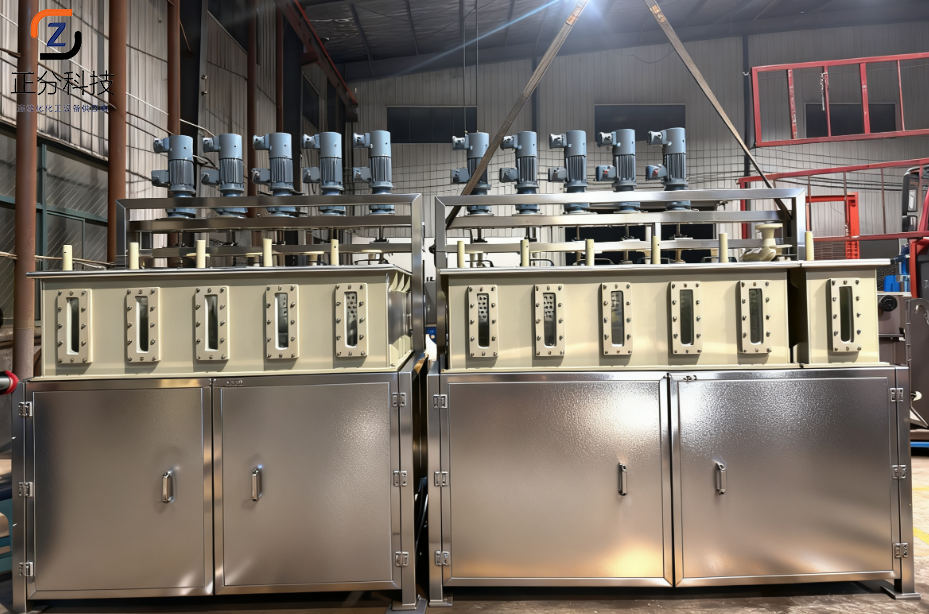
Although the mixer-settler has significant advantages in the copper extraction process from copper tailings, it still faces problems such as large floor space, easy accumulation of impurities in the tank, and sensitivity to feed fluctuations in practical applications. To further improve the application effect and operational efficiency, the following optimization strategies can be adopted.
For the problem of large floor space, a vertical smooth flow (VSF) mixer-settler can be adopted. This type of mixer-settler, developed by Outokumpu, splits the mixing and pumping actions of the traditional pump-mixer into a DOP pumping impeller and one or more double-helix spirok mixers, which provide low-shear agitation. The dispersion enters the settler through a central vertical uptake and flows through a primary distributing fence and two sets of non-jetting picket fences, and the depth of the settler gradually increases toward the weir box at the discharge end to reduce velocity and entrainment. This structural design can reduce the floor space by 30~40% compared with the traditional horizontal mixer-settler, while ensuring the extraction efficiency.
For the problem of impurity accumulation, a self-cleaning mixing chamber can be designed, and a slag discharge port can be added at the bottom of the mixing chamber and the settling chamber to regularly discharge accumulated impurities and fine mud, avoiding the blockage of the agitator and coalescence plates and ensuring stable operation of the equipment.
Establish a real-time monitoring system for key parameters of the mixer-settler, including the concentration of copper ions in the aqueous phase and organic phase, pH value, temperature, stirring speed, and phase interface position. Through online monitoring and automatic adjustment, the parameters can be kept in the optimal range, avoiding the impact of manual operation errors and feed fluctuations on the extraction effect. For example, the pH value of the leachate and the concentration of the extractant can be monitored in real time, and the addition amount of the extractant and the pH adjuster can be automatically adjusted to ensure the stability of the extraction rate.
Optimize the stirring speed and mixing time according to the characteristics of the copper tailing leachate. For leachate with high impurity content and fine mud, the stirring speed can be appropriately reduced to avoid emulsification; for leachate with low copper concentration, the mixing time can be appropriately extended to improve the mass transfer efficiency.
Optimize the preprocessing and leaching processes of copper tailings to reduce the content of fine mud and impurities in the leachate, reducing the burden of the mixer-settler and avoiding emulsification and blockage. For example, a cyclone classification device can be added after the grinding stage to remove fine mud with a particle size of less than 20μm, improving the quality of the leachate.
Match the number of mixer-settler stages according to the copper concentration of the leachate and the required recovery rate. For leachate with low copper concentration (below 1g/L), the number of extraction stages can be increased to 5~7 stages to ensure the enrichment effect; for leachate with high copper concentration (above 2g/L), the number of extraction stages can be reduced to 3~4 stages to reduce energy consumption and equipment investment.
As a key hydrometallurgical equipment, the mixer-settler has irreplaceable advantages in the copper extraction process from copper tailings, which can effectively solve the industry pain points such as low recovery rate, high impurity content, high energy consumption, and serious pollution in traditional processes. Through its application in the extraction, washing, and stripping stages of the solvent extraction process, it can realize the precise enrichment of low-concentration copper ions, deep separation of impurities, and closed-loop utilization of extractants, improving the recovery rate of copper resources, reducing production costs, and achieving environmental protection and energy saving.
With the continuous development of green mining and intelligent metallurgy, the future development trend of mixer-settlers in the field of copper tailing copper extraction will focus on three aspects: first, intelligence, integrating Internet of Things, big data, and artificial intelligence technologies to realize full-process intelligent monitoring, parameter automatic adjustment, and fault early warning, improving operational efficiency and stability; second, miniaturization and high efficiency, optimizing the structural design to further reduce the floor space and energy consumption while improving the extraction efficiency; third, environmental protection and diversification, developing environmentally friendly extractants and mixer-settler systems suitable for complex copper tailings (such as high-arsenic, high-lead copper tailings), realizing the synergistic recovery of multiple valuable metals (such as copper, cobalt, and nickel) in copper tailings, and maximizing the resource value of copper tailings.
In conclusion, the rational application and continuous optimization of mixer-settlers are of great significance for promoting the recycling of copper tailing resources, realizing the green and sustainable development of the copper mining industry, and alleviating the shortage of copper resources. It is expected that with the continuous innovation of technology and the expansion of application scenarios, mixer-settlers will play a more important role in the field of copper tailing copper extraction.
Focus on being Continuous chemical equipment
provider.
If you want to learn more about our centrifugal extractor, mixer settler, Contact us Now