
Continuous chemical equipment
provider
provider
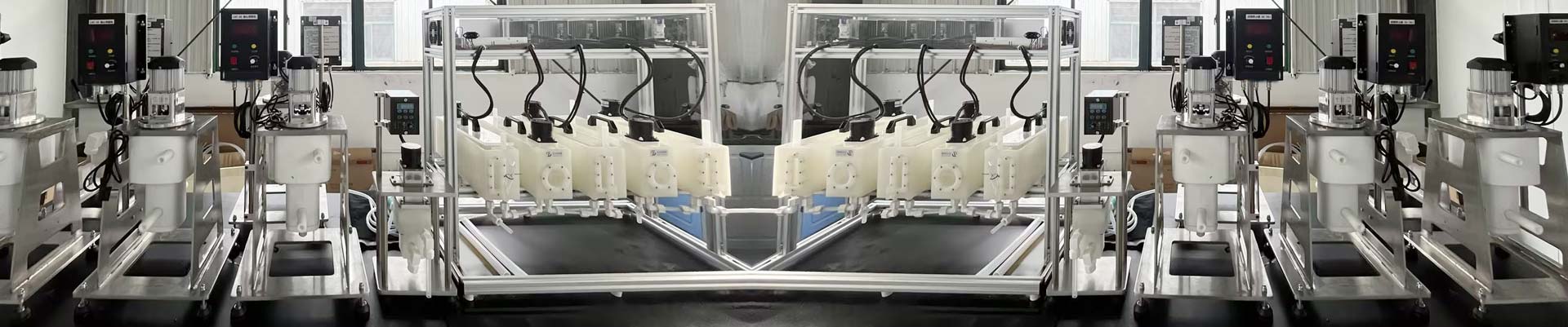
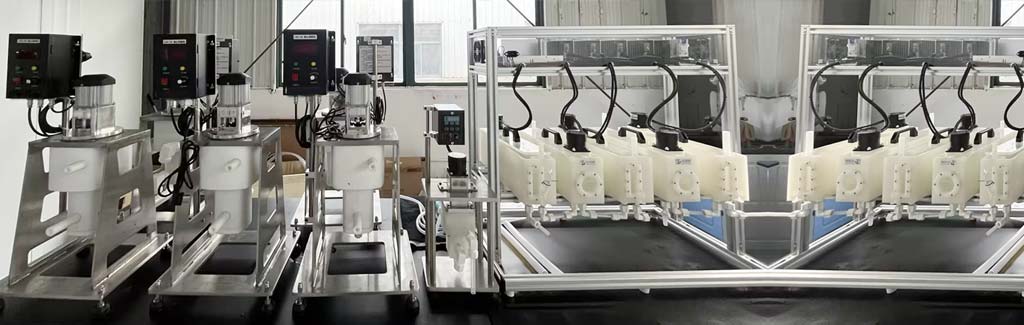
The global transition to green energy has driven an unprecedented surge in the production and adoption of electric vehicles (EVs) and energy storage systems, which rely heavily on power lithium batteries. As these batteries reach the end of their service life—typically 8 to 15 years—an enormous volume of spent power lithium batteries is being generated, creating both urgent environmental challenges and valuable resource opportunities. However, the current recycling industry faces three core pain points: low recovery rates of critical metals (especially lithium, cobalt, and nickel), high energy consumption and environmental costs of traditional recycling technologies, and poor adaptability to the complex and variable composition of spent batteries. To address these challenges, there is an urgent need for efficient, low-cost, and environmentally friendly recycling technologies that can realize the high-value recovery of critical metals while minimizing environmental impact. The mixed settler, a classic liquid-liquid extraction equipment based on the principle of gravity separation, has emerged as a key solution to these industry pain points. This article comprehensively explores the application of mixed settlers in spent power lithium battery resource recycling, including its working principle, process integration, technical advantages, industrial application cases, existing challenges, and future development trends.
The global stockpile of spent power lithium batteries is expected to exceed 11 million tons by 2030, with China alone recycling over 300,000 tons annually in 2024, corresponding to a market scale of 48 billion yuan (approximately 6.6 billion US dollars). These spent batteries contain valuable critical metals such as lithium (Li), cobalt (Co), nickel (Ni), and manganese (Mn), as well as hazardous materials including electrolytes, heavy metals, and organic binders. If not properly treated, they can cause severe soil, water, and air pollution, while the waste of critical metals exacerbates the supply shortage of raw materials for the lithium battery industry. Currently, the mainstream recycling technologies for spent power lithium batteries are divided into pyrometallurgy (smelting) and hydrometallurgy (leaching-extraction). Pyrometallurgy is characterized by simple process and strong adaptability but suffers from high energy consumption (over 25 kWh/m³), low metal recovery rates (less than 70% for lithium), and high emissions of harmful gases. Hydrometallurgy, which includes leaching, extraction, purification, and precipitation, has the advantages of high recovery rates and low energy consumption, but its application is limited by the inefficiency of extraction equipment and the difficulty in handling low-concentration, high-impurity leachate from spent batteries.
The development of the spent power lithium battery recycling industry is hindered by three key pain points that urgently need to be addressed:
First, low recovery rates of critical metals. The leachate from spent lithium batteries typically has low concentrations of lithium (3-5 g/L) and complex impurities (such as Na⁺, Mg²⁺, Fe³⁺, and Al³⁺), making it difficult to achieve efficient separation and recovery with traditional extraction equipment. For example, the lithium recovery rate of traditional evaporation crystallization processes is only 65-70%, resulting in a huge waste of valuable resources. Second, high energy consumption and environmental costs. Traditional hydrometallurgical processes require large amounts of acids, alkalis, and energy, leading to high operating costs and environmental pollution. For instance, the alkali consumption of traditional wet processes reaches 1.2 tons of NaOH per ton of Li₂CO₃, and the treatment cost of waste liquid is high, which is not in line with the "dual carbon" goal of green and low-carbon development. Third, poor adaptability to complex working conditions. Spent power lithium batteries have diverse chemistries (including ternary lithium, lithium iron phosphate, and lithium manganese oxide), and their leachates have varying concentrations and impurity compositions. Traditional extraction equipment (such as centrifugal extractors) is prone to blockage and emulsification when handling high-suspension (3-5%) and high-viscosity leachates, resulting in unstable operation and reduced processing efficiency.
Against the background of the growing scale of the spent lithium battery recycling market and increasingly strict environmental regulations, the industry has clear technical demands for recycling equipment: first, high separation efficiency, which can significantly improve the recovery rates of lithium, cobalt, nickel, and other critical metals, ideally reaching more than 97%; second, low energy consumption and environmental friendliness, which can reduce the consumption of chemicals and energy, minimize waste liquid emissions, and meet environmental protection standards; third, strong adaptability, which can handle leachates with different concentrations and impurity compositions, ensuring stable long-term operation; fourth, low operating costs and easy scalability, which is suitable for large-scale industrial application and can help enterprises improve profitability. The mixed settler, with its unique structural design and working principle, perfectly meets these technical demands and has become a core equipment in the hydrometallurgical recycling process of spent power lithium batteries.
A mixed settler, also known as an extraction tank, is a stage-wise contact liquid-liquid mass transfer device that relies on gravity to achieve phase separation. Its core structure consists of two parts: a mixing chamber and a settling chamber, which work together to complete the extraction and separation of target metals (such as lithium, cobalt, and nickel) from the leachate of spent lithium batteries. The specific working process is as follows: first, the leachate (aqueous phase) and the extractant (organic phase) are fed into the mixing chamber in a certain proportion. Under the action of a stirring device, the two phases are fully mixed to form an emulsion, and the target metal ions in the aqueous phase are selectively combined with the extractant to transfer from the aqueous phase to the organic phase. Then, the emulsion flows into the settling chamber, where the organic phase and the aqueous phase are naturally stratified due to their density difference—the organic phase (loaded with target metals) floats on the upper layer, and the aqueous phase (remaining impurities) settles at the lower layer. Finally, the two phases are separately discharged through overflow weirs to complete the extraction and separation process.
In the recycling of spent power lithium batteries, mixed settlers are usually used in a multi-stage series mode, with supporting washing sections, stripping sections, and regenerating sections, forming a closed-loop separation system. This multi-stage design can significantly improve the separation efficiency, ensuring that the target metal ions are fully extracted and purified, and the extractant can be recycled after regeneration, reducing resource waste and operating costs.
The leachate of spent power lithium batteries has the characteristics of low target metal concentration, complex impurities, high suspension content, and large viscosity, which puts forward higher requirements for the structure of mixed settlers. To adapt to these special working conditions, industrial-grade mixed settlers have been optimized in structure and design:
First, the optimization of the mixing chamber. The mixing chamber adopts a combined design of axial-radial stirring paddles, which forms a three-dimensional cross-flow stirring effect, effectively reducing the size of liquid droplets to 0.1-0.5 mm, significantly improving the mass transfer efficiency between the two phases, and ensuring that the target metal ions and the extractant are fully combined. At the same time, the stirring speed is adjustable, which can be flexibly adjusted according to the composition and viscosity of the leachate, avoiding emulsification caused by excessive stirring and insufficient mixing caused by insufficient stirring.
Second, the optimization of the settling chamber. The height of the overflow weir in the settling chamber is optimized, and a coalescing packing layer is added, which can stabilize the thickness of the emulsion layer at 5-8 cm, reduce the dosage of demulsifier by 30%, and avoid the blockage of the equipment by suspended solids. In addition, the bottom of the settling chamber is designed with a slope, which is convenient for the discharge of sediment and reduces the maintenance frequency of the equipment.
Third, the optimization of material selection. The contact parts of the mixed settler with the leachate and extractant are made of corrosion-resistant materials (such as polypropylene, PVDF, or titanium alloy), which can resist the corrosion of acids, alkalis, and organic solvents in the leachate, extending the service life of the equipment and ensuring stable operation under long-term industrial conditions.
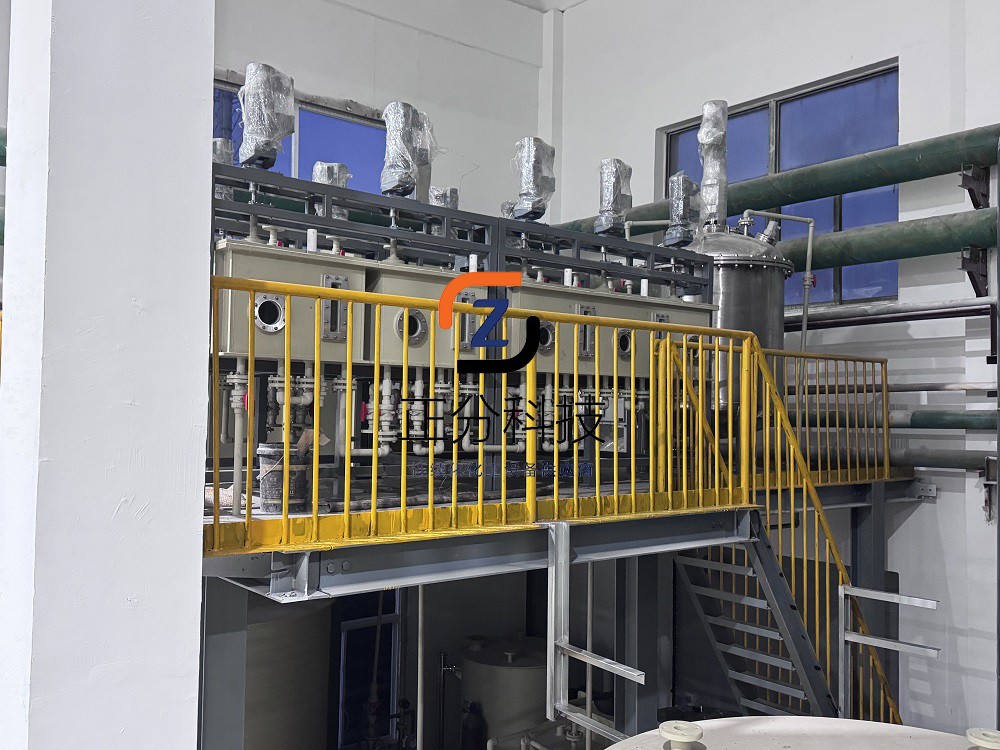
The application of mixed settlers in spent power lithium battery recycling is closely integrated with the hydrometallurgical process, covering the entire process from pretreatment of spent batteries to the recovery of target metals. The specific process includes four key links: pretreatment of spent batteries, leaching of critical metals, extraction and separation by mixed settlers, and purification and recovery of target metals. Each link is closely connected to form a complete recycling chain, ensuring the efficient recovery of critical metals and the harmless treatment of waste.
Pretreatment is the foundation of efficient recycling, whose purpose is to remove harmful substances in spent batteries, separate useless components, and create suitable conditions for subsequent leaching and extraction. The pretreatment process mainly includes three steps: discharge, disassembly, and thermal pyrolysis.
First, discharge. Spent power lithium batteries still have residual electricity, which may cause short circuits, fires, or explosions during disassembly and processing. Therefore, the first step is to discharge the batteries safely. Common discharge methods include physical discharge (such as short-circuit discharge with a resistor) and chemical discharge (such as immersion in a neutral salt solution), which can reduce the residual voltage of the batteries to below 0.5 V to ensure operational safety.
Second, disassembly. The discharged batteries are disassembled manually or mechanically to separate the shell, positive electrode, negative electrode, separator, and electrolyte. The shell is made of aluminum or steel, which can be recycled separately; the separator is made of polypropylene or polyethylene, which is usually treated as hazardous waste after harmless treatment; the electrolyte contains toxic and corrosive substances (such as lithium hexafluorophosphate), which needs to be collected and treated separately to avoid environmental pollution.
Third, thermal pyrolysis. The positive and negative electrode materials are subjected to low-temperature thermal pyrolysis at 200-300℃ to remove the organic binder (such as PVDF) on the electrode surface, and then crushed by air flow to separate the electrode powder from the aluminum foil or copper foil. The separated aluminum foil and copper foil can be recycled as metal materials, and the electrode powder (containing lithium, cobalt, nickel, and other critical metals) is used as the raw material for subsequent leaching.
The pretreated electrode powder is leached with acid or alkali to dissolve the critical metals (lithium, cobalt, nickel, etc.) into the solution, forming a leachate. The choice of leaching agent depends on the type of electrode material: for ternary lithium battery electrode powder (containing LiCoO₂, LiNiO₂, LiMn₂O₄, etc.), sulfuric acid or hydrochloric acid is usually used as the leaching agent, and a reducing agent (such as hydrogen peroxide) is added to reduce the high-valent metal ions (such as Co³⁺, Ni³⁺) to low-valent ions, improving the leaching rate; for lithium iron phosphate battery electrode powder (LiFePO₄), phosphoric acid or sulfuric acid is used as the leaching agent, and a catalyst is added to promote the dissolution of lithium and iron.
After leaching, the leachate is filtered to remove insoluble impurities (such as graphite, carbon black, and residual binder), and then adjusted to an appropriate pH value (1.5-9.0, depending on the type of extractant) and added with a buffer to remove suspended impurities, avoiding emulsification or equipment blockage in the subsequent extraction process. For example, when treating lithium precipitation mother liquor, the pH value needs to be adjusted to 1.5-2.0 to make lithium ions exist in a form that is easier to be extracted.
The pretreated leachate is fed into the multi-stage mixed settler system for extraction and separation, which is the core link of realizing the separation of target metals and impurities. According to the composition of the leachate, different extractant systems are selected to achieve the selective extraction of target metals:
For the leachate of ternary lithium batteries (high content of cobalt and nickel), a composite extractant system composed of β-diketones and ionic liquids is selected, with sulfonated kerosene as the diluent. Through 4-stage countercurrent extraction (residence time of 15-30 minutes per stage), cobalt and nickel ions are selectively extracted into the organic phase, while lithium and other impurities remain in the aqueous phase. The extraction rates of cobalt and nickel can reach more than 99%, and the separation coefficient of Li/Co is more than 1000, realizing the efficient separation of cobalt, nickel, and lithium.
For the lithium precipitation mother liquor or lithium iron phosphate battery leachate (high content of lithium, low content of other metals), a TBP-FeCl₃ synergistic extraction system (adding 5% Cyanex923) is adopted. Under the action of stirring, lithium ions form a (Li·FeCl₄·2TBP) complex, which is transferred to the organic phase, and impurities such as Na⁺ and Mg²⁺ remain in the aqueous phase. The lithium extraction rate can reach more than 97%, and the separation coefficient of Li/Na exceeds 1000, solving the problem of low lithium recovery rate in traditional processes.
After extraction, the organic phase loaded with target metals enters the washing section of the mixed settler, and the residual impurity ions in the organic phase are removed through multi-stage washing to ensure the purity of the final product. The washed organic phase enters the stripping section, and contacts fully with 0.5-1 mol/L dilute sulfuric acid or hydrochloric acid stripping solution, so that the target metal ions are eluted from the organic phase into the aqueous phase, forming a high-purity metal solution. The stripped organic phase is regenerated by distillation and returned to the extraction section for recycling, with a recycling rate of 98% and a solvent loss of less than 0.2%.
The high-purity metal solution obtained after stripping is further purified and recovered to obtain battery-grade metal products. For the lithium-rich solution, saturated sodium carbonate solution is added, and the reaction is carried out at 70℃ to generate battery-grade lithium carbonate (purity ≥99.5%). The filtered mother liquor is returned to the pretreatment process for recycling, realizing the closed-loop utilization of resources. For the cobalt-rich and nickel-rich solutions, impurity removal (such as removing iron, aluminum, and manganese by precipitation) is carried out first, and then cobalt and nickel are recovered by electrolysis or precipitation to obtain cobalt carbonate, nickel carbonate, or metal cobalt and nickel, which can be directly used in the production of new lithium battery electrode materials.
The raffinate generated in the extraction process (the aqueous phase after extracting target metals) contains a small amount of impurities and residual extractant. After neutralization and precipitation treatment, the COD is reduced to below 50 mg/L, and the treatment cost is only 1 yuan/m³, which meets the requirements of the "Pollution Control Standard for the Recycling of Power Batteries" and can be discharged or recycled after reaching the standard.
Compared with traditional extraction equipment (such as centrifugal extractors, pulse extraction columns) and recycling technologies (such as pyrometallurgy, evaporation crystallization), mixed settlers have obvious technical advantages in the recycling of spent power lithium batteries, which can effectively solve the core pain points of the industry and improve the economic and environmental benefits of recycling enterprises. The specific advantages are as follows:
The multi-stage countercurrent extraction design of mixed settlers can significantly improve the extraction efficiency of target metals. For low-concentration, high-impurity leachate from spent lithium batteries, the lithium recovery rate can be increased from less than 70% of traditional processes to more than 97%, and the recovery rates of cobalt and nickel can reach more than 99%. For example, in a Qinghai salt lake lithium precipitation mother liquor recovery project, 6-stage series mixed settlers were used, and the lithium recovery rate was increased from 65% to 96%, which is equivalent to creating an "invisible lithium mine" for enterprises and greatly improving the utilization rate of lithium resources. In the recycling project of spent lithium iron phosphate batteries in Shandong Liancui, the "low-temperature pyrolysis-low acid leaching-mixed settler extraction" integrated process was adopted, and the lithium recovery rate reached 98.2%, realizing the high-value recovery of lithium resources.
Mixed settlers rely on gravity for phase separation, which requires only low stirring energy consumption (less than 15 kWh/m³), which is much lower than the evaporation crystallization process (more than 25 kWh/m³) and centrifugal extractor (more than 20 kWh/m³). At the same time, the efficient synergistic extraction system matched with mixed settlers can reduce the alkali consumption to 0.7 tons of NaOH per ton of Li₂CO₃, which is 42% lower than the traditional wet process (1.2 tons of NaOH per ton of Li₂CO₃). The treatment cost of raffinate is 98% lower than that of traditional processes, which greatly reduces the operating cost of enterprises. According to the industrial application data of Guangdong Guanghua Technology, after adopting the mixed settler technology, the profit per ton of battery recycling increased by more than 2,000 yuan, effectively improving the profitability of enterprises. In addition, the closed-loop utilization of extractants and the harmless treatment of raffinate can minimize environmental pollution, which is in line with the green and low-carbon development trend of the industry.
The leachate of spent power lithium batteries has complex composition, high suspension content (3-5%), and large viscosity fluctuation, which is easy to cause blockage and emulsification of traditional extraction equipment. The mixed settler adopts the design of gravity stratification and adjustable turbine stirring, which can adapt to leachates with different concentrations, viscosities, and impurity contents, and the stable continuous operation rate reaches 99%. Compared with the centrifugal extractor, which has a short separation time (only a few seconds), the mixed settler has a residence time of several minutes per stage, which is more suitable for the slow kinetic complexation reaction between lithium ions and extractants, avoiding the efficiency loss caused by insufficient reaction. In addition, the simple structure of the mixed settler is easy to maintain and operate, and the maintenance cost is low, which is suitable for large-scale industrial continuous production.
Compared with centrifugal extractors and other high-precision extraction equipment, the manufacturing cost of mixed settlers is 30-50% lower, and the investment threshold for enterprises is lower. At the same time, mixed settlers can be flexibly combined into multi-stage systems according to the processing scale and recovery requirements, and the processing capacity can be adjusted from several cubic meters per hour to hundreds of cubic meters per hour, which is suitable for both small and medium-sized recycling enterprises and large-scale industrial recycling bases. For example, the Qinghai salt lake lithium precipitation mother liquor recovery project adopts a 6-stage series mixed settler system with a processing scale of 100 m³/h, which realizes large-scale and efficient lithium recovery.
With its unique technical advantages, mixed settlers have been widely used in large-scale industrial projects of spent power lithium battery recycling at home and abroad, and have achieved remarkable economic, environmental, and social benefits. The following are three typical industrial application cases to illustrate the practical application effect of mixed settlers:
The project is located in Qinghai Province, China, mainly dealing with the lithium precipitation mother liquor of salt lakes, which has the characteristics of high magnesium-lithium ratio (Mg/Li > 20) and low lithium concentration (3-4 g/L), and the traditional process has low lithium recovery rate and high energy consumption. To solve this problem, the project adopted a 6-stage series mixed settler system, matched with a TBP-FeCl₃ synergistic extraction system, to realize the efficient extraction and recovery of lithium.
After industrial operation, the lithium recovery rate of the project was increased from 65% to 96%, the energy consumption was reduced by 50% compared with the traditional evaporation crystallization process, and the annual emission of waste salt was reduced by more than 100,000 tons, which greatly improved the comprehensive utilization efficiency of salt lake lithium resources. At the same time, the cost of lithium recovery was reduced by 35%, and the annual additional economic benefit was more than 50 million yuan, realizing the dual goals of resource utilization and environmental protection.
The project is a large-scale spent lithium iron phosphate battery recycling base in Shandong Province, China, with an annual processing capacity of 50,000 tons of spent lithium iron phosphate batteries. The project adopted the "low-temperature pyrolysis-low acid leaching-mixed settler extraction" integrated process, and used an 8-stage mixed settler system to extract and purify lithium from the leachate.
Industrial operation data show that the lithium recovery rate of the project reached 98.2%, the purity of the regenerated lithium carbonate was ≥99.5%, and the regenerated lithium iron phosphate cathode material had a specific capacity of ≥155 mAh/g, and the capacity retention rate was ≥85% after 1000 cycles, which fully met the requirements of power battery remanufacturing. The project's energy consumption per ton of batteries was reduced by 40% compared with the traditional process, and the waste water and waste gas were discharged up to standard, realizing the green and high-value recycling of spent lithium iron phosphate batteries.
The project is a key project of spent ternary lithium battery recycling in Guangdong Province, China, mainly dealing with the nickel-cobalt extraction residual liquid of spent ternary lithium batteries, which contains low-concentration lithium (2-3 g/L) and trace impurities such as Ni²⁺ and Co²⁺. The project adopted a mixed settler system matched with a TBP-FeCl₃ synergistic extraction system to recover lithium from the residual liquid.
After industrial application, the lithium recovery rate of the project reached 97.5%, the residual content of Ni²⁺/Co²⁺ in the lithium-rich solution was less than 10 ppm, and the purity of the produced battery-grade lithium carbonate reached 99.9%, which fully met the requirements of power battery production. The project's extractant recycling rate reached 98%, the solvent loss was less than 0.2%, and the profit per ton of battery recycling increased by more than 2,000 yuan, effectively improving the economic benefits of the enterprise and promoting the upgrading of the ternary lithium battery recycling industry.
Although mixed settlers have significant advantages in the recycling of spent power lithium batteries, they still face some challenges in practical industrial application, which need to be solved through technical innovation and process optimization:
First, the problem of emulsification in the extraction process. When the leachate of spent lithium batteries contains high concentrations of suspended solids or organic impurities, emulsification is easy to occur in the mixing chamber of the mixed settler, which affects the phase separation efficiency and reduces the recovery rate of target metals. At present, the main solution is to add a demulsifier, but this will increase the operating cost and may introduce new impurities.
Second, the adaptability to new battery technologies. With the development of the lithium battery industry, new types of batteries (such as semi-solid and all-solid-state batteries) are gradually put on the market. The composition and structure of these batteries are quite different from traditional liquid electrolyte batteries, and their leachates have higher viscosity and more complex impurity compositions, which puts forward higher requirements for the structure and extractant system of mixed settlers.
Third, the automation level is low. Most of the current mixed settler systems rely on manual operation to adjust parameters such as stirring speed, feed flow rate, and extractant ratio, which has low automation level, large human error, and is not conducive to the stable operation of the system and the improvement of recovery efficiency.
In response to the above challenges, combined with the development trend of the spent power lithium battery recycling industry, the application of mixed settlers will develop in three directions: intelligence, low-alkalinity, and integration:
First, intelligent regulation. With the development of artificial intelligence and sensor technology, mixed settler systems will introduce online concentration monitoring, AI parameter optimization, and other technologies to realize real-time monitoring of key parameters (such as pH value, metal ion concentration, and phase interface height) in the extraction process, and automatically adjust stirring speed, feed flow rate, and extractant ratio to improve separation accuracy and efficiency. For example, the AI-based risk estimation framework can predict potential hazards in the extraction process in advance, reducing the occurrence of emulsification and equipment failure, and improving the operational reliability of the system.
Second, adaptation to low-alkalinity extraction systems. At present, the extraction process of mixed settlers mostly requires adjusting the leachate to a low pH value (1.5-2.0), which will increase the corrosion of equipment and the consumption of acids. In the future, researchers will develop efficient extractants suitable for neutral or weakly alkaline conditions (pH 8-9), which can reduce the consumption of acids and alkalis, reduce equipment corrosion, and further reduce operating costs and environmental pollution.
Third, process integration. Mixed settlers will be deeply integrated with other technologies (such as membrane separation, adsorption, and electrochemical extraction) to build a closed-loop system of "intelligent disassembly-green leaching-efficient extraction-material regeneration". This integrated system can realize the full utilization of resources, reduce the generation of waste, and help achieve the industry goals of energy consumption ≤300 kWh per ton of batteries and water consumption ≤5 tons per ton of batteries, promoting the sustainable development of the spent lithium battery recycling industry.
In the context of the global energy transition and the increasing shortage of critical metal resources, the recycling of spent power lithium batteries has become an important part of the circular economy and the green development of the lithium battery industry. The mixed settler, as a core extraction equipment in the hydrometallurgical recycling process, has solved the core pain points of the industry (low recovery rate, high energy consumption, poor adaptability) with its advantages of high recovery rate, low energy consumption, strong adaptability, and low investment, and has been widely used in industrial projects, achieving remarkable economic, environmental, and social benefits.
With the continuous iteration of battery technology and the increasingly strict environmental regulations, the mixed settler will continue to be optimized and upgraded in terms of structure, extractant system, and automation level, and will be more closely integrated with new technologies such as artificial intelligence and membrane separation. It is believed that in the future, mixed settlers will play a more important role in the recycling of spent power lithium batteries, promoting the formation of a closed-loop industrial chain of "production-use-recycling" of lithium batteries, and making greater contributions to the realization of global carbon neutrality and the sustainable development of the green energy industry.
Focus on being Continuous chemical equipment
provider.
If you want to learn more about our centrifugal extractor, mixer settler, Contact us Now